US : Signals Possible Tariff Relief for India Amid Russian Oil Import Decline
US: The United States has indicated that it may reconsider the additional 25 percent tariffs imposed on India, following a sharp decline in India’s purchases of Russian oil. The signal came from senior US leadership during high-level discussions at the World Economic Forum in Davos, highlighting how trade pressure has influenced global energy flows and diplomatic negotiations. The development has added a new dimension to ongoing debates over energy security, sanctions, and evolving geopolitical alliances.
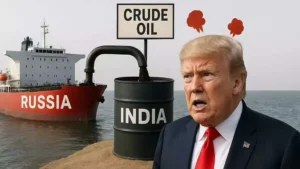
US Assessment of Tariff Impact
According to US officials, the tariff policy has delivered measurable results. Indian refineries, which had significantly increased imports of discounted Russian crude after the Ukraine conflict, have reportedly reduced such purchases sharply. Washington views this shift as proof that trade measures can alter market behaviour when aligned with broader strategic objectives. While the tariffs remain in place for now, US leadership has suggested that there is a potential diplomatic pathway for their removal if current trends continue.
The argument from the American side is that tariffs are not merely punitive tools but instruments designed to reshape supply chains and reinforce economic priorities. Officials have emphasized that the reduced flow of Russian oil into Indian refineries reflects a broader success in discouraging indirect support for Moscow’s war economy.
India’s Energy Strategy and Policy Position
New Delhi, however, continues to maintain that its energy decisions are guided by domestic needs rather than geopolitical pressure. With a population exceeding 1.4 billion, India has consistently stated that affordable and reliable energy remains a national priority. Government representatives have reiterated that India’s energy policy is rooted in strategic autonomy, allowing the country to diversify suppliers while keeping costs manageable for consumers.
Indian authorities have also confirmed that they are closely monitoring legislative developments in the United States, particularly proposals that could introduce far steeper penalties on countries importing Russian oil. While acknowledging these discussions, New Delhi has avoided committing to any abrupt policy shifts, signaling a careful balancing act between global expectations and internal economic realities.
Potential Escalation Through US Legislation
The debate has intensified in Washington, where lawmakers are considering a bill that could impose duties as high as 500 percent on countries continuing to buy Russian oil. Supporters of the legislation argue that stronger measures are needed to curb revenue streams that sustain Russia’s military operations. Critics, however, warn that such extreme tariffs could disrupt global energy markets and strain relations with key partners like India.
For India, the prospect of such penalties introduces additional uncertainty into long-term energy planning. While recent data suggests reduced Russian imports, policymakers remain cautious about external constraints that could limit flexibility in sourcing crude oil from global markets.
European Role and Trade Contradictions
The situation has also drawn criticism toward Europe’s approach to Russian energy. US officials have openly questioned the logic of European countries purchasing refined petroleum products from India that originate from Russian crude. This practice, they argue, undermines Europe’s stated commitment to reducing financial flows to Russia, while indirectly sustaining them through third-party trade.
At the same time, Europe is moving forward with ambitious trade negotiations with India. A comprehensive free trade agreement between the European Union and India is under discussion, envisioned as one of the most significant trade deals in recent history. European leaders have described the proposed agreement as transformative, potentially covering a market of two billion people and a substantial share of global economic output.
Strategic Calculations Ahead
Observers note that Europe’s reluctance to impose similar tariffs on India may be driven by its desire to secure this landmark trade agreement. From Washington’s perspective, this highlights inconsistencies in how allies apply economic pressure in pursuit of geopolitical goals. From Europe’s standpoint, India is increasingly seen as an indispensable economic partner in a rapidly shifting global order.
As India, the United States, and the European Union navigate these overlapping interests, the future of tariffs, energy sourcing, and trade cooperation remains fluid. Any decision to lift or maintain US tariffs on India is likely to depend not only on oil import data but also on broader strategic calculations involving diplomacy, economic growth, and global stability.