Delhi to face air pollution and traffic congestion from November 1st, these vehicles will be barred from entry.
Delhi to face air pollution: Vehicles registered outside Delhi that do not have BS-6 engines will not be permitted entry into Delhi as of November 1st, according to a notification released by the Delhi Transport Department. Only BA-6, CNG, LNG, and EV (electric car) vehicles are allowed entry into Delhi. The purpose of this regulation is to reduce pollution.
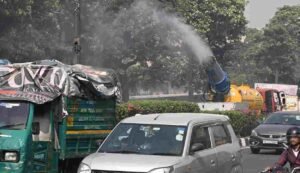
Up to October 31, 2026, commercial cars with Bharat Stage 4 (BS-4) engines are permitted entry into Delhi. Private cars are not eligible for this exemption; only BS-4 business vehicles are. Only Delhi-registered commercial cars are permitted to operate in Delhi. The agency claims that any commercial goods vehicles registered outside of Delhi that do not meet BS-VI criteria would be prohibited from entering the nation’s capital starting on November 1 in accordance with the Commission for Air Quality Management’s (CAQM) mandate. BS-VI compliant cars adhere to tighter emission requirements, which help to reduce pollution, according to a public notice released by the Transport Department.
The CAQM meeting on October 17 agreed to a full ban on the entrance of polluting commercial vehicles, which will take effect on November 1, in response to Delhi’s pollution issues. As a temporary remedy, a notification from the Transport Department permits BS-IV commercial freight trucks to enter Delhi till October 31, 2026.
These cars will be excluded.
Until October 31, 2026, commercial goods vehicles registered in Delhi, diesel vehicles that comply with BS-VI and BS-IV regulations, and vehicles that operate on CNG, LNG, or electric power would all be allowed access. The notification also said that while a certain phase of the Graded Response Action Plan (GRAP) is in operation, limitations on commercial goods trucks under such phases would remain in force.
Transporters’ reaction and subsequent plan
Transporters hoped that the government would continue to exclude cars that met BS-IV regulations from entering Delhi. According to Bhim Wadhwa of the All India Motor Transport Congress, BS-IV compliant cars would be permitted entry for a period of one year. The All India Motor and Goods Transport Association’s Rajendra Kapoor said that a meeting will be held to decide on the next step.
The worrying AQI was the reason for the decision.
After Delhi’s AQI hit dangerously high levels, the decision about cars was made. Information from monitoring stations painted a bleak picture of the air quality during the night of October 20–21, when Delhi was oppressively hot. Ashok Vihar recorded a hazardous level of 892, Chandni Chowk 998.8, while a station close to the Supreme Court reached 959. However, the official tracking system had already begun to malfunction by 10:45 p.m., when 22 of 39 sites had exceeded the severe plus category of air pollution.
Less than a third of the monitoring stations—just 11—were continuously recording data during the worst hours of the smog on Diwali night, according to an analysis of Central Pollution Control Board data by India Today. This resulted in significant and suspicious gaps in the city’s official record of the air emergency.
Out of 39 air quality monitoring stations in operation, only 11 reported Air Quality Index (AQI) values during the nighttime, while data from the remaining 28 stations was unavailable, particularly during the hours of worst pollution.
On October 21, between midnight and 5 a.m., when pollution levels peaked, the majority of the data gaps were noted. This timeframe is crucial for assessing real-time air quality, as it is when pollution levels tend to rise significantly, impacting public health.
Despite the high levels of pollution during this period, the absence of data from the 28 stations raises serious concerns about the current air quality monitoring infrastructure. Not only does this make it difficult to assess the actual air quality at critical times, but it also poses a potential threat to public health, as citizens are left uninformed about hazardous air conditions.
This situation begs the question of why such a large number of stations failed to provide data during these crucial hours. Was it due to technical issues, or were these stations lacking the necessary resources and equipment for proper monitoring? Without addressing these questions, it will be difficult to assess pollution accurately and take timely action in the future.
Such reports highlight the urgent need to strengthen the air quality monitoring system to ensure that we can effectively track pollution levels in real-time and protect public health by providing timely and accurate information.