Judiciary – Supreme Court Declines Early Challenge to Vande Mataram Advisory
Judiciary – The Supreme Court on Wednesday declined to entertain a petition that questioned a government advisory related to the singing of Vande Mataram in schools and public gatherings, stating that the concerns raised were premature and lacked concrete grounds.
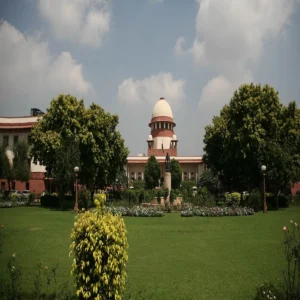
Court calls plea speculative and premature
A bench led by Chief Justice Surya Kant, along with Justices Joymalya Bagchi and Vipul M. Pancholi, observed that the petition was based on hypothetical fears rather than any actual instance of discrimination. The court advised the petitioner, Muhammed Sayeed Noori, to approach the judiciary only if a real violation of rights occurs.
The bench made it clear that there was no immediate cause for judicial intervention, emphasizing that the advisory had not resulted in any enforceable action against individuals so far.
Advisory nature of circular highlighted
During the hearing, the court underlined that the government’s circular was merely advisory and did not impose any legal obligation. Chief Justice Kant pointed out that the guidelines did not carry any punitive provisions, nor did they compel individuals to comply under threat of legal consequences.
The judges reiterated that participation in such activities remains voluntary under the current framework, and there is no mandate requiring individuals to sing the national song.
Concerns raised over individual freedom
Senior advocate Sanjay Hegde, representing the petitioner, argued that while respect for national symbols is important, compelling individuals to participate in singing Vande Mataram could infringe upon personal beliefs and freedom of conscience.
He stressed that patriotism cannot be enforced and warned that even without formal penalties, social pressure could lead individuals to feel obligated to participate against their will. According to him, this could affect people of different faiths as well as those with non-religious beliefs.
Debate on national song versus national anthem
Hegde also raised a constitutional distinction between the national anthem and the national song, stating that both do not hold identical legal status. He referred to the Home Ministry’s directive suggesting that the national song be played before the anthem and cautioned that this could alter the traditional significance of the anthem.
He expressed concern that the longer duration of Vande Mataram might overshadow the national anthem, potentially diminishing its importance during official or public events.
Bench questions absence of enforcement
The judges repeatedly questioned whether there had been any instance where individuals were penalized or excluded for not participating in the singing of the national song. Justice Bagchi specifically asked if the advisory contained any clause imposing penalties for non-compliance.
In response, Hegde acknowledged that while no direct legal punishment was specified, individuals might still face indirect consequences such as social discomfort or pressure.
However, the bench maintained that such possibilities did not amount to a legal violation warranting immediate judicial review.
Emphasis on voluntary participation
Justice Bagchi pointed out that the wording of the directive itself suggested flexibility, noting that it used the term “may,” indicating optional participation. He clarified that the advisory allows individuals the freedom both to participate and to refrain.
The court reaffirmed that if any situation arises where a person faces discrimination or coercion due to the advisory, legal remedies would be available at that stage.
Government perspective and constitutional duty
Although not formally representing the government in the case, Solicitor General Tushar Mehta remarked that citizens are expected to respect national symbols as part of their constitutional duties under Article 51A. He questioned whether such respect should even require formal advisories.
Petition dismissed without further action
Concluding the hearing, the Supreme Court dismissed the petition, reiterating that no actionable harm had been demonstrated. The bench maintained that judicial intervention is appropriate only when there is clear evidence of rights being violated.
The ruling underscores the court’s position that hypothetical concerns alone are insufficient to challenge advisory guidelines, especially in the absence of enforcement or discrimination.