Prime Minister Narendra Modi called Ayushman Bharat Yojana a revolutionary step related to Delhi’s health sector
New Delhi: Regarding Delhi’s health sector, Prime Minister Narendra Modi referred to the Pradhan Mantri Ayushman Bharat Health Infrastructure Mission (PM-ABHIM)’s execution as a “revolutionary step” on Friday.
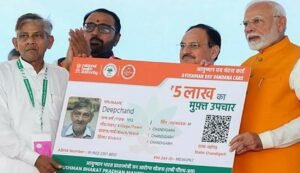
On Thursday, the Delhi government began distributing Ayushman Bharat cards as part of the Pradhan Mantri Jan Arogya Yojana (PM-JAY) and launched the Pradhan Mantri Ayushman Bharat Health Infrastructure Mission (PM-ABHIM).
Prime Minister Narendra Modi said on social media: “A groundbreaking move for Delhi’s healthcare system! Thousands of my brothers and sisters here will greatly benefit from this double-engine government mission. The fact that Delhiites may now get treatment under the Ayushman Yojana makes me extremely delighted.
“Today, a new chapter has been added to Delhi’s health sector,” Delhi Chief Minister Rekha Gupta said in a post. The Delhi government has begun distributing Ayushman Bharat cards under the Pradhan Mantri Jan Arogya Yojana (PM-JAY) and implemented the Pradhan Mantri Ayushman Bharat Health Infrastructure Mission (PM-ABHIM) in recognition of the goal of “Healthy India, Strong India”, which is led by Hon. Prime Minister Shri @narendramodi ji.
“The Honourable Prime Minister has my sincere gratitude for this significant undertaking. This is a tangible step in the direction of #ViksitDelhi,” the post says.
On April 5, the Delhi government and the National Health Authority (NHA) of the Union Ministry of Health and Family Welfare (MoHFW) signed a Memorandum of Understanding (MoU), making Delhi the 35th State and Union Territory to implement the Ayushman Bharat Pradhan Mantri Jan Arogya Yojana (AB PM-JAY).
Economically disadvantaged groups are protected financially by this government-sponsored health insurance program, which covers hospitalisation expenses up to Rs 5 lakhs per household per year.
Launched on September 23, 2018, Ayushman Bharat PM-JAY was primarily designed for the nation’s millions of impoverished and vulnerable households. Within five years, it allowed them to get high-quality healthcare in a timely manner without having to pay exorbitant medical bills in the event of an emergency.