Shashi Tharoor : Reaffirms Party Discipline While Prioritizing National Security Interests
Shashi Tharoor: The recent remarks by senior Congress Member of Parliament Shashi Tharoor have reignited discussion around internal party dynamics, freedom of expression, and the broader question of national interest. Speaking at a public interaction during the Kerala Literature Festival, Tharoor clarified his position on reported differences with the Congress leadership and firmly stated that he has never violated the official stand of his party inside Parliament.
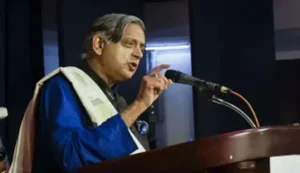
Public Clarification at a Literary Forum
Addressing questions from the audience at the Kerala Literature Festival, Tharoor dismissed speculation that he has been acting independently of party discipline. He emphasized that throughout his parliamentary career, he has remained aligned with the Congress party’s stated positions. According to him, the only instance where he openly expressed a principled disagreement was related to Operation Sindhoor, and even then, it was rooted in national security concerns rather than political defiance.
Context Behind the Reported Differences
In recent weeks, media reports have suggested growing unease between Tharoor and sections of the Congress leadership. These reports pointed to perceived sidelining by state leaders and dissatisfaction over Congress leader Rahul Gandhi allegedly not acknowledging Tharoor’s presence at a public event in Kochi. Responding to these narratives, Tharoor maintained that such interpretations are exaggerated and distract from more substantive issues facing the country.
The Pahalgam Incident and a Strong Opinion
Tharoor explained that his controversial comments originated from a newspaper column he authored following the Pahalgam incident. As a writer and long-time observer of international affairs, he argued that the attack should not go unanswered. He advocated for a kinetic response that would send a clear message without escalating into a wider conflict. His stance, he noted, was driven by strategic reasoning rather than political positioning.
Balanced Approach Toward Pakistan
Elaborating further, Tharoor stressed that while India’s primary focus remains economic growth and development, national security cannot be compromised. At the same time, he cautioned against being drawn into a prolonged confrontation with Pakistan. According to him, any response should be precise and limited, specifically aimed at terrorist infrastructure rather than triggering a full-scale conflict. This balanced approach, he argued, reflects responsible leadership in a complex geopolitical environment.
Government Action Mirrors His View
Interestingly, Tharoor pointed out that the Indian government eventually adopted a course of action similar to what he had suggested in his column. He expressed surprise at this alignment, indicating that his views were not radical or outside the mainstream national security discourse. For him, this underscored that his comments were guided by India’s interests rather than party politics.
India First, Above All Politics
Invoking the legacy of India’s first Prime Minister Jawaharlal Nehru, Tharoor recalled the famous question, “Who lives if India dies?” He used this historical reference to reinforce his belief that when the nation’s security and global standing are at stake, political differences must take a back seat. In such moments, he asserted, India must come first.
Differences Within Democracy
Concluding his remarks, Tharoor acknowledged that disagreements among political parties are a natural part of democracy and contribute to building a stronger nation. However, he drew a clear distinction between ideological debate and matters of national interest. While political contestation is healthy, safeguarding the country’s security and unity should always remain the highest priority.