White House talks: Trump-Putin meeting may affect the future of Ukraine
US: It’s likely that Monday’s White House meeting will be even more important for Ukraine’s future and the security of all of Europe than the US-Russia summit in Alaska last Friday.
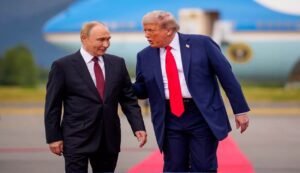
That Putin-Trump reunion seemed to meet all expectations at first glance.
No big statements, no penalties, and no ceasefire were made.
Were the two leading nuclear powers in the world preparing to shut Ukraine and Europe out of a pact hatched behind closed doors?
Apparently not, unless Ukraine and its allies can stop it.
President Zelensky’s visit to Washington with Sir Keir Starmer, President Macron, Chancellor Merz, and other leaders is about more than just preventing him from being ambushed in the Oval Office as he was on February 28.
They want Donald Trump to understand two things: first, that a peace agreement for Ukraine cannot be reached without direct Ukrainian participation, and second, that it must be supported by “cast-iron” security assurances.
Above all, European leaders want the US President to recognize that Ukraine and Europe are united, and they want to make sure that his clear personal relationship with Vladimir Putin isn’t influencing him to cave in to the demands of the Russian authorities.
Trump will be visiting the UK on a state visit in a month, and he enjoys and listens to Starmer.
‘The Trump Whisperer,’ Mark Rutte, the NATO Secretary-General who will be there, is another person he loves.
The White House has harshly criticized President Macron’s plan to unconditionally recognize a Palestinian state at the next UN General Assembly, and the US president seems to have less affection for him.
Something needs to give for a peace agreement in Ukraine to have any chance of succeeding.
In addition to President Zelensky’s repeated declarations that he would not cede territory and that Ukraine’s constitution prohibits it, European leaders have repeatedly said that international boundaries cannot be altered by force.
However, Putin has no intention of ever returning Crimea and wants the Donbas, where his troops now control around 85% of it.
However, as Kaja Kallas, the former prime minister of Estonia and now the leading diplomat in Europe, recently told me, Ukraine’s triumph in this conflict should not be limited to retaking seized territory.
It would be a success for Ukraine if it could get the kind of Article 5-style security assurances that are now being discussed, enough to prevent any further Russian invasion and preserve its independence as a free and independent state.
A deal that essentially exchanges some Ukrainian territory for security assurances that it won’t have to cede any more to Russia seems to be what the US and Russia have been debating.
However, there are a lot of questions.
Given that thousands of people have died attempting to rescue that land, could Ukraine accept a compromise that ends the conflict but loses its territory?
Will the route west to Kyiv be severely underdefended if it is required to cede the remaining 30% of Donetsk Oblast that Russia has not yet occupied?
What about the renowned Coalition of the Willing, which Starmer had established?
Since then, there has been less discussion of putting tens of thousands of troops on the ground.
As Ukraine rebuilds its army, the focus has shifted to “protecting skies and seas.”
However, we are still in a perilous area even if there is a lull in the fighting.
According to every military analyst I’ve talked to, Putin will reassemble his army and produce additional weaponry as soon as the combat ceases, perhaps within three or four years, putting him in a position to seize more territory.
A courageous pilot of an F35 or Typhoon will be ready to launch the first missile against a Russian column that is approaching, if and when that occurs.