Think tank calls Donald Trump’s claim of ‘India buying huge amount of Russian oil’ false and misleading
US: According to the think tank Global Trade Research Initiative (GTRI), Donald Trump’s assertions that China purchases more Russian oil than India and that India is purchasing large quantities of Russian oil and “selling” it on the open market are false and deceptive.
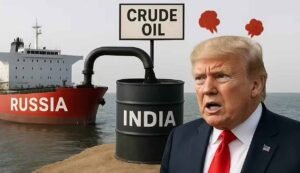
It said that as Western sanctions upset established supply lines, New Delhi increased its imports of Russian oil in part to help stabilize the world’s oil markets.
In response to the US President’s warning to increase the tariff that India must pay for purchasing “massive amounts of Russian oil,” GTRI founder Ajay Srivastava said, “Trump has targeted India, but China buys more oil.”
Srivastava said that Mr. Trump’s move to increase tariffs on India, citing the country’s oil trade, is not only unwarranted but also disregards market realities, falsifies trade statistics, and jeopardizes a crucial Indo-Pacific strategic alliance.
India does not export crude oil, the GTRI said.
India exports no crude oil worldwide and is a net importer of the commodity. Like many other energy-importing nations, India does export refined petroleum products, including Russian oil, such as jet fuel and diesel, after processing crude oil in its refineries,” the statement said.
“Secondly, the biggest consumer of Russian oil is China, not India,” it said.
India purchased $52.7 billion worth of Russian oil in 2024, while China imported $62.6 billion. However, Mr. Trump unjustly singles out India and seems hesitant to criticize China, perhaps due to geopolitical considerations, Srivastava said.
He said that there is complete transparency and mutual understanding between the United States and Russia in the oil transaction between India and Russia.
India increased its imports of Russian oil in part to stabilize the world’s oil markets after the disruption of conventional supply channels caused by Western sanctions. India helped avert a global oil price shock by preserving varied and reasonably priced energy availability,” he added.
According to Srivastava, India’s oil refineries, which include both state-owned and private sector companies, source crude oil on their own and don’t need permission from the government to purchase from Russia or any other nation.
Commercial factors, including pricing, supplier stability, and export market laws, influence their purchasing choices,” he stated.
According to the creator of GTRI, refiners may decide to cut down on or cease such purchases on their own if they determine that the dangers of importing Russian crude—such as secondary sanctions or losing access to important export markets—outweigh the financial benefits of cheap oil.
For example, India’s exports of aviation turbine fuel (ATF) and diesel to the EU in FY2025 would now stop since the EU has banned goods made from Russian oil. Without waiting for a government order, Indian refiners would instinctively switch away from Russian oil in such circumstances,” he added.
According to Srivastava, India’s imports from Russia decreased by 9.8% to $9.2 billion in May 2025 as compared to the May 2024 purchase.
India’s reaction to Donald Trump’s assertion
Trump said Monday he would “substantially” increase US duties on New Delhi in a new trade threat against the country, accusing it of purchasing large quantities of Russian oil and reselling it for large profits.
The Trump administration imposed a 25% levy on all Indian exports last week. Although it was not mentioned in the notice, the US President also declared a penalty for purchasing the “vast majority” of Russian crude oil and military hardware.
“India is not only purchasing enormous quantities of Russian oil, but they are also selling a large portion of that oil on the open market for significant profits,” Trump posted on social media on Monday.
They don’t give a damn about the number of people the Russian War Machine is killing in Ukraine. As a result, I will be significantly increasing the tariff that India pays to the United States,” he said.
India responded by stating that it is looking into the effects of the tariffs and that it would take all necessary measures to protect and advance the national interest.
India is researching the effects of tariffs
India is the world’s fastest-growing major economy, according to New Delhi, after Trump launched a scathing assault on Russia and India last week for their close connections, saying the two nations can bring down their “dead economies together.”
“India is our friend, but we have, over the years, done relatively little business with them because their tariffs are far too high, among the highest in the world, and they have the most strenuous and obnoxious non-monetary Trade Barriers of any country,” Trump said, claiming that the US has a massive trade deficit with India.
“At a time when everyone wants Russia to stop the killing in Ukraine, they are Russia’s biggest energy buyer, along with China, and they have always purchased the great majority of their military hardware from Russia— Everything is not good!” Trump had said.
According to New Delhi, it is still optimistic of reaching a fair, balanced, and mutually beneficial trade deal and is researching the effects of these tariffs.