India signs deal with French company Safran for fifth generation fighter aircraft
New Delhi:In the process of developing its fifth-generation fighter aircraft, India has made significant progress. India will produce its fifth-generation fighter jet’s engine domestically, according to Defense Minister Rajnath Singh. The ‘mummy’ of the Rafale jet’s M88 engine, Safran, will now provide a high-thrust engine for India’s Advanced Medium Combat Aircraft program. AMCA‘s ‘kidney’ will be this engine, which will provide it with supercruise, stealth, and great precision. Experts predict that India’s Air Force will become one of the most powerful in the world thanks to this technology, which would put it ahead of 5th generation fighter planes like Russia’s SU-57 and America’s F-35.
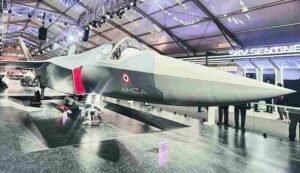
It was announced by Rajnath Singh at the ‘Economic Times World Leaders Forum.’ “India has made significant progress today in the construction of a fifth-generation fighter aircraft,” he remarked. Together with the French business Safran, we will begin producing fighter aircraft engines in India.
The ‘stealth’ might of India
An important step toward India’s Advanced Medium Combat Aircraft project will be this agreement. The Aeronautical Development Agency is spearheading this initiative, and private businesses will play a significant role as well.
India’s first homegrown stealth-heavy multi-role fighter aircraft is regarded as the AMCA. It will be a 25-ton twin-engine aircraft that can hold up to 6.5 tons of fuel inside. It will be equipped with next-generation avionics, sensor fusion, an internal weapon bay, and supercruise capabilities.
For AMCA, the government has already authorized an initial expenditure of Rs 15,000 crore. According to experts, India’s design and technology can match, if not surpass, fifth-generation fighter aircraft like Russia’s Su-57 and the United States’ F-35.
What makes this agreement significant?
India’s fighter planes have always relied on foreign engines. Regardless of the Sukhoi-30MKI or Tejas, there has been no reliance on engines at all. However, now that Safran, the manufacturer of Rafale engines, has partnered with India, the country will not only be self-sufficient but will also have the ability to export engine technology in the future.
India initiated ‘Operation Sindoor’ after the terror assault in Pahalgam in April of last year. Since then, there has been a greater focus on domestic defense manufacturing and Air Force modernization. This AMCA and engine manufacturing agreement is regarded as a component of the same series.
What characteristics will India’s fifth-generation fighter aircraft have?
- Capacity and weight: 25-ton twin-engine aircraft with an internal fuel capacity of 6.5-ton.
- Technical characteristics include sensor fusion, an internal weapons bay, supercruise (supersonic speed without afterburner), next-generation avionics, and stealth (radar protection).
- Function: Multi-role fighter with the ability to conduct electronic warfare, air defense, and deep assaults.
- Cost: It is projected that the project would initially cost Rs 15,000 crore.
Rivalry between the F-35 and Su-57
Safran, a French firm, is regarded as the leading engine manufacturer in the world. It produces engines for other military aircraft in addition to the Rafale. In the next decades, India’s expanding aerospace capabilities combined with Safran’s expertise might place it among the most advanced air forces in the world.
Experts predict that AMCA’s advanced design, Safran’s engine technology, and the aircraft’s stealth capabilities will enable it to surpass aircraft such as Russia’s Su-57 and America’s F-35. The cheap cost and sophisticated characteristics of AMCA would make India a “game-changer” in air combat when compared to aircraft like the F-35 and Su-57. an is the reason why the military community is talking about how an Indian “desi hunter” may take over the world’s sky in the near future.