AviationDispute – Supreme Court Upholds Rs 144.5 Crore Deposit Order
AviationDispute – The Supreme Court on Friday declined to interfere with a Delhi High Court directive requiring SpiceJet and its chairman Ajay Singh to deposit Rs 144.5 crore in an ongoing financial dispute with businessman Kalanithi Maran and KAL Airways Pvt Ltd. The top court’s decision brings another decisive moment in a case that has stretched across more than a decade.
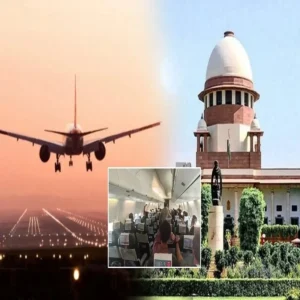
Supreme Court Refuses Relief to Airline
A bench comprising Justices PS Narasimha and Alok Aradhe dismissed the plea filed by the airline and Singh. The court also imposed a cost of Rs 1 lakh on Singh while rejecting the challenge to the High Court’s order.
With this ruling, the Supreme Court effectively affirmed the High Court’s recent direction, reinforcing earlier judicial findings in the prolonged corporate conflict.
Roots in SpiceJet’s Financial Turmoil
The dispute traces back to early 2015, when SpiceJet was facing a severe financial crisis that threatened to halt its operations. At the time, Kalanithi Maran and KAL Airways Pvt Ltd were majority stakeholders, collectively holding over 58 percent of the airline’s shares.
In January 2015, as part of an emergency restructuring effort, the parties entered into a Share Sale and Purchase Agreement. Under this arrangement, Maran and KAL Airways agreed to transfer their entire stake to Ajay Singh for a nominal sum of Rs 2. The deal included provisions involving warrants and cumulative redeemable preference shares, with an overall funding commitment estimated at around Rs 450 crore.
However, disagreements soon emerged over whether the contractual commitments were honoured by both sides. These differences eventually led to arbitration proceedings.
Arbitral Award and Subsequent Challenges
In July 2018, a three-member arbitral tribunal ruled in favour of Maran and KAL Airways. The tribunal directed SpiceJet and Singh to refund Rs 308.21 crore along with annual interest at 12 percent from November 2015.
Both parties later moved to challenge parts of the award under the Arbitration and Conciliation Act, 1996. At the same time, steps were initiated to enforce the award, setting off a lengthy series of hearings before the Delhi High Court and the Supreme Court.
During earlier proceedings, the High Court had instructed SpiceJet to deposit Rs 579 crore. That directive was subsequently modified, allowing the airline to furnish a Rs 329 crore bank guarantee along with a Rs 250 crore cash deposit.
In 2019, Rs 250 crore was released to Maran and KAL Airways, while Rs 58.21 crore was paid through encashment of the bank guarantee.
Supreme Court’s 2023 Directions
The dispute intensified in February 2023 when the Supreme Court ordered encashment of the bank guarantee and directed SpiceJet and Singh to pay Rs 75 crore towards accrued interest within three months. The bench had made it clear that failure to comply would result in the arbitral award becoming fully executable.
When the airline later sought additional time to meet the payment obligation, the court declined the request in July 2023. It observed that non-compliance meant the award could be enforced in full.
High Court’s Fresh Order and Final Rejection
Earlier this year, the Delhi High Court examined fresh applications filed by SpiceJet and Singh seeking to halt enforcement of the award. The court noted that previous directions of the Supreme Court had not been adhered to.
Invoking Article 144 of the Constitution, which mandates all authorities to act in support of the Supreme Court, the High Court pointed out that the judgment debtors had acknowledged an outstanding interest liability of Rs 194.51 crore. After accounting for Rs 50 crore already deposited, the court directed payment of the remaining Rs 144.5 crore.
SpiceJet and Singh once again approached the Supreme Court to challenge this direction. On Friday, the apex court dismissed their petition, leaving the High Court’s order intact.
The ruling underscores the judiciary’s consistent stance in enforcing arbitral awards and ensuring compliance with court directives in high-value corporate disputes within the aviation sector.