A Flash of Fury in Parliament: Rajnath Singh Challenges Opposition on ‘Himmat’…
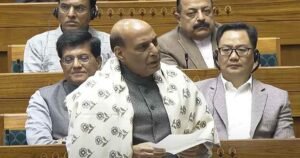
A Flash of Fury in Parliament: Defence Minister Rajnath Singh ignited the Lok Sabha floor on Monday, delivering a powerful and deeply emotional speech concerning the national song, ‘Vande Mataram’. The proceedings took a dramatic turn when Opposition lawmakers attempted to interrupt his address, testing the Minister’s composure. A now-viral video captures the intensely charged moment where Singh, losing his cool, vehemently confronted his interrupters. His furious retort—”Who is going to make me sit? Who will make me sit?”—followed by the sharp command, “What are you even saying? Sit down! How dare you?”—highlighted the gravity of the subject matter. The ensuing chaos saw many BJP members rallying to his support, vocally challenging the Opposition’s audacity. The parliamentary Speaker, Om Birla, was eventually compelled to intervene, gesturing for calm among the protesting MPs.
Accusations of Appeasement: The ‘Vande Mataram’ Controversy
In his blistering critique, Rajnath Singh targeted the Congress party, holding them responsible for what he termed the “fragmentation” of ‘Vande Mataram.’ He attributed this historical marginalization to the party’s decades-long “appeasement politics,” a practice he asserted began during the era of former Prime Minister Jawaharlal Nehru. Singh passionately argued that the restoration of the national song’s inherent glory is not only “the need of the hour” but a moral imperative. He lamented the historic “unequal treatment” given to the national song when compared to the national anthem, viewing this as a profound injustice that extends beyond the song itself to the people of independent India. This perceived injustice, he insisted, was a deliberate move and the genesis of a much larger political strategy.
Unbiased Evaluation: Dispelling Historical Myths
The Defence Minister called for an immediate and unbiased evaluation of the song and its true historical context. He squarely refuted the long-held notion that ‘Vande Mataram’ or the book from which it originated, Anand Math, was ever “anti-Islam.” Instead, Singh asserted that the text accurately reflected the popular anti-establishment sentiments directed against the Nawab of Bengal and the prevailing British imperialism of the time. While the first two stanzas are widely recognized, Singh pointed out that the majority of the original song, which truly depicts the “essence of India,” has regrettably been forgotten. He concluded by insisting that now is the definitive time to revisit and understand the unadulterated history of this iconic composition.
PM Modi’s Tribute: The 150-Year Legacy
The significant parliamentary debate was spearheaded by Prime Minister Narendra Modi, who initiated the discussion by celebrating the upcoming 150-year anniversary of ‘Vande Mataram.’ Written by Bankim Chandra Chatterjee and first published in 1875, the Prime Minister emphasized its monumental contribution to India’s freedom struggle. Modi defined the song as more than a simple tune; it was a “sacred war cry” that served to unify the nation and inspire its liberation from colonialism. He proudly noted that the song “stood like a rock” against the British attempt to divide Bengal in 1905, serving as an unwavering symbol of unity and national pride.
The Emergency: A Dark Chapter Recalled
During his address, PM Modi seized the opportunity to draw a stark parallel between the historical marginalization of the song and a dark period in modern Indian history: the Emergency. He pointedly reminded the Parliament that when ‘Vande Mataram’ completed its 100th year, the nation was enduring the “throttling” of its Constitution. He described the Emergency as a time when genuine patriots were imprisoned, highlighting it as a “dark chapter.” Modi passionately argued that the present moment offers a unique and crucial opportunity to fully restore the greatness and national prominence of ‘Vande Mataram,’ an opportunity he believes should not be lost.
Political Backlash and Call for Focus
The debate’s intensity was fueled by a recent political row, stemming from the PM’s prior accusation that the Congress deliberately dropped important stanzas of the song in 1937. The Congress, however, maintained that the omission was based on Rabindranath Tagore’s advice and was an act of accommodation for the beliefs of other communities. Responding to the proceedings, Congress leader Priyanka Gandhi Vadra accused the Centre of deliberately resurrecting the issue—especially given the approaching assembly election in Bengal—as a distraction from genuine national concerns. She urged the government to set aside the “insults” to Nehru for a dedicated debate and then move on, prioritizing the crucial legislative work that the people elected them to perform.