Religion – Centre Defends Temple Traditions in Supreme Court Hearing
Religion – The Union government has told the Supreme Court that Hindu traditions historically accord a place of deep respect to women, often elevating them above men in matters of worship and belief. Presenting its arguments before a nine-judge Constitution bench, the Centre defended long-standing temple customs while responding to petitions concerning gender-based access to religious sites, including the Sabarimala temple issue.
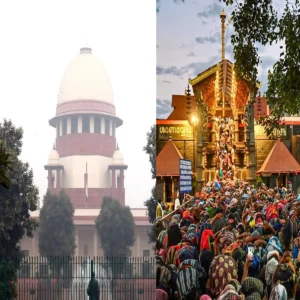
Government Highlights Diversity in Religious Practices
Solicitor General Tushar Mehta, representing the Centre, pointed to several temples across India where entry restrictions are based on established customs rather than discrimination. He argued that such practices reflect the diversity of rituals within Hinduism and cannot be judged solely through the lens of equality provisions without considering religious freedom.
According to the Centre, traditions at certain temples restrict entry for men under specific conditions, demonstrating that such practices are not exclusively directed at women. These examples were presented to underline that faith-based customs vary widely and are shaped by centuries-old beliefs.
Reference to Sabarimala Judgment
The government also questioned the reasoning behind the 2018 judgment that allowed entry of women aged 10 to 50 into the Sabarimala temple. Mehta argued that the verdict appeared to rest on the assumption of male superiority, which, he said, does not align with the broader philosophical framework of Hinduism.
He emphasized that religious practices, including rituals and modes of worship, are protected under constitutional provisions related to freedom of religion. These rights, he added, must be interpreted carefully alongside principles of equality.
Temples with Unique Gender-Based Traditions
To support its position, the Centre cited several temples where access rules differ based on gender and specific rituals:
- In Kerala’s Attukal Bhagavathy Temple, men are not allowed to enter on the main day of the Pongal festival, which draws one of the largest gatherings of women devotees.
- At the Chakkulathukavu Temple, a ritual known as Naari Puja is observed, where only women are permitted inside while a male priest performs ceremonial acts honoring female devotees.
- The Brahma Temple in Pushkar follows a tradition where married men avoid entering the inner sanctum due to beliefs associated with marital harmony.
- At the Bhagavati Amman Temple in Kanyakumari, customs linked to the deity’s spiritual significance restrict entry for married men.
- In a temple in Muzaffarpur, Bihar, men are completely barred during a specific period, including male priests.
- Kerala’s Kottankulangara temple observes a unique ritual where men dress as women to offer prayers.
- The Kamakhya Temple in Assam restricts male entry during the Ambubachi period, when the goddess is believed to undergo a natural cycle, and only female priests conduct rituals.
These examples, the Centre argued, illustrate that entry norms are often rooted in belief systems rather than inequality.
Argument on Faith and Constitutional Interpretation
The Centre maintained that concepts like patriarchy or gender bias should not be automatically applied to religious traditions without examining their historical and cultural context. It stressed that Hinduism has long embraced the idea of worshipping feminine power, with goddesses occupying a central place in spiritual practices.
Mehta further submitted that constitutional guarantees under Articles 25 and 26, which protect religious freedom, require a balanced approach. Courts, he said, must carefully weigh these rights alongside equality provisions instead of applying a uniform standard.
Ongoing Deliberations
The Constitution bench is currently examining broader questions related to religious freedom, equality, and the extent of judicial intervention in faith-based practices. The outcome is expected to have implications not only for the Sabarimala issue but also for similar disputes involving religious customs across the country.
The case continues to draw attention for its complex intersection of law, belief, and societal values, with the court expected to deliver a judgment that addresses both constitutional principles and cultural traditions.