Artificial Intelligence – Modi Unveils MANAV Vision at AI Summit
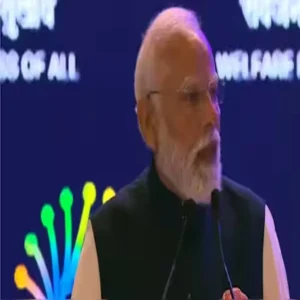
Artificial Intelligence – Prime Minister Narendra Modi on Thursday presented India’s comprehensive vision for artificial intelligence at the AI Impact Summit in New Delhi, urging global leaders to adopt a human-centred and responsible approach as the technology reshapes economies and societies.
A Human-Centric Framework for AI
Addressing delegates at the summit, Mr. Modi introduced what he described as the “MANAV” framework for artificial intelligence. The term, which means “human,” is structured as an acronym outlining five guiding principles: a moral and ethical foundation, accountable governance, national sovereignty with an emphasis on data rights, accessible and inclusive innovation, and systems that are valid and legitimate.
He said these pillars are intended to ensure that technological progress remains aligned with human values and national interests. According to the Prime Minister, the rapid evolution of AI demands clear norms and institutional safeguards so that its benefits are widely shared while risks are carefully managed.
Comparing AI to Historic Technological Shifts
Drawing parallels with earlier technological breakthroughs, Mr. Modi described artificial intelligence as a turning point comparable to the advent of wireless communication. He noted that when wireless signals were first transmitted, few anticipated a world connected instantly across continents. In a similar way, he said, AI is poised to redefine the contours of daily life and global interaction.
He emphasized that the current phase represents only the beginning of AI’s long-term impact. What may seem transformative today, he suggested, could soon be viewed as an early chapter in a much larger technological journey.
Expanding Human Capabilities
The Prime Minister underlined that artificial intelligence should not be viewed merely as a tool to enhance machines. Instead, he said, its true potential lies in strengthening human capability. From healthcare and agriculture to education and governance, AI applications are already improving efficiency and access, he noted.
He pointed out that the pace of technological change has accelerated dramatically. Innovations that once required decades to mature are now unfolding within years. The progression from traditional machine learning models to more advanced, adaptive systems is happening at a speed and scale that previous generations did not experience.
According to Mr. Modi, the world is moving into a period where people and intelligent systems will increasingly collaborate. He described this emerging phase as one of co-creation and co-evolution, in which human judgment and machine intelligence complement each other.
Global Participation at Bharat Mandapam
The summit, being held at Bharat Mandapam, has drawn significant international participation. Over five days, from February 16 to 20, the event is expected to host more than 500 global AI leaders along with 150 academics and researchers. Around 400 chief technology officers, vice-presidents, and philanthropists are also attending discussions and policy sessions.
On the sidelines of the event, Mr. Modi welcomed several prominent global figures to the venue, including Antonio Guterres, Secretary-General of the United Nations, and Kristalina Georgieva, Managing Director of the International Monetary Fund. Their presence underscores the growing importance of international cooperation in shaping AI standards and regulatory frameworks.
Focus on Responsible and Inclusive Growth
Throughout his address, the Prime Minister reiterated that artificial intelligence must serve humanity rather than replace it. He stressed the importance of safeguarding national data, ensuring transparent oversight, and making advanced technologies accessible to developing nations.
As countries race to harness AI for economic growth and strategic advantage, India’s MANAV approach seeks to balance innovation with accountability. The summit discussions are expected to cover regulatory models, cross-border collaboration, and practical applications across sectors.