Yunus Government : No Place for Mob Violence in a Transforming Bangladesh Sends Strong Message
Yunus Government: The interim government led by Muhammad Yunus in Bangladesh has strongly condemned the brutal lynching of a Hindu garment worker accused of blasphemy, declaring that such acts of violence have no place in what it calls a “New Bangladesh.” The incident has taken place amid a wider atmosphere of unrest and political instability following the death of a prominent student leader, raising serious concerns about law, order, and communal harmony in the country at a critical political moment.
Background of the Lynching Incident
Dipu Chandra Das, a young Hindu man working in the garment sector, was living as a tenant in the Dubalia Para area of Bhaluka Upazila in the Mymensingh region. According to police accounts, a group of local residents accused him of making derogatory remarks about Prophet Muhammad. On Thursday night around 9 pm, the situation escalated rapidly, and the mob allegedly beat him severely, leading to his death.
This tragic incident has once again highlighted the dangers of mob justice and the vulnerability of minority communities during periods of political and social tension. The killing has drawn national and international attention, particularly because it occurred at a time when Bangladesh is attempting to navigate a sensitive democratic transition.
Government’s Official Response and Condemnation
In a strong official statement issued from Dhaka, the Yunus-led interim administration unequivocally condemned the killing. The government stated that there is absolutely no justification for such brutality and that no individual involved in the crime would be spared from legal consequences. It emphasized that violence based on religious accusations undermines the very foundations of justice and social coexistence.
The administration also urged citizens across the country to remain alert against what it described as isolated extremist and terrorist groups attempting to exploit the prevailing unrest. According to the statement, acts of fear, arson, vandalism, and destruction are being firmly rejected, as they threaten to derail Bangladesh’s progress toward peace and democratic stability.
Call for Restraint During Democratic Transition
The interim government underlined that Bangladesh is passing through a historic phase of democratic transformation. At such a critical juncture, it warned that attempts to create chaos and instability would not be tolerated. The leadership appealed for restraint, responsibility, and collective commitment to rejecting hate-driven actions.
Officials stressed that meaningful change and reform cannot be achieved through violence, and that public anger, however intense, must be expressed through lawful and peaceful means. The message was clear that the state will act decisively to protect citizens and preserve constitutional order.
Context of Widespread Protests and Political Unrest
The lynching occurred against the backdrop of violent protests in Dhaka and other parts of the country following the death of Sharif Osman Hadi. Hadi was a student leader and spokesperson of the radical group Inquilab Mancha, and he played a significant role in the July 2024 uprising that contributed to the fall of the previous government.
Known for his strong opposition to former prime minister Sheikh Hasina and his openly critical stance toward India, Hadi was shot by unidentified assailants on December 12 and later succumbed to his injuries. His death triggered immediate outrage among supporters, who took to the streets demanding justice and swift arrests.
Escalation Into Arson and Targeted Attacks
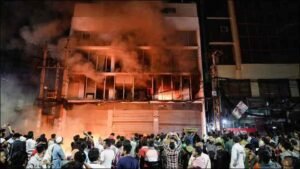
What began as protests soon spiraled into widespread disorder. Demonstrators engaged in arson and vandalism, targeting institutions perceived to be aligned with the former administration or foreign interests. In Dhaka, mobs attacked and set fire to the offices of leading newspapers such as Prothom Alo and The Daily Star, trapping dozens of journalists inside and placing lives at risk.
Several symbolic sites were also targeted, including the residence of Sheikh Mujibur Rahman, Bangladesh’s founding father, and multiple cultural centers. These actions have raised alarm about the safety of public institutions and the shrinking space for free expression during times of unrest.
Solidarity With Journalists and Press Freedom
In its statement, the Yunus administration expressed strong solidarity with journalists from The Daily Star, Prothom Alo, and New Age who were affected by the attacks. The government offered an apology for the fear and violence faced by media professionals and praised their courage in continuing to uphold truth under dangerous circumstances.
It emphasized that attacks on journalists are attacks on truth itself and assured that full justice would be delivered. This assurance was seen as an important signal of the interim government’s commitment to press freedom and democratic values.
Rising Anti-India Sentiment and Diplomatic Concerns
The unrest has also taken on a pronounced anti-India tone. Protesters have alleged that the killers of Sharif Osman Hadi fled to India, a claim that remains unverified. Demonstrators have demanded the closure of the Indian High Commission in Dhaka, adding a diplomatic dimension to the internal crisis.
Such sentiments have further complicated the situation, as regional stability and bilateral relations risk being affected by domestic political turmoil and misinformation.
Conclusion: Upholding Law and Harmony in New Bangladesh
The Yunus-led government’s response to the lynching and the wider unrest reflects an attempt to assert moral authority and restore confidence in the rule of law. By condemning violence unequivocally, standing with journalists, and calling for restraint, the administration is signaling its vision for a Bangladesh built on justice, accountability, and peaceful coexistence.
As the country approaches its scheduled general election, the coming weeks will be crucial in determining whether Bangladesh can overcome this period of instability and move forward on a path of inclusive and democratic governance.