A Storm Over Vande Mataram: What Made Mallikarjun Kharge Take On Amit Shah
A Storm Over Vande Mataram: The Rajya Sabha, the upper house of the Indian Parliament, witnessed a significant debate on Tuesday (December 9th) to commemorate the 150th anniversary of the national song, ‘Vande Mataram’. Initiating the discussion, Union Home Minister Amit Shah hailed ‘Vande Mataram’ as a symbol of patriotism, sacrifice, and national consciousness. He strongly asserted that those questioning the relevance and timing of this discussion must re-evaluate their perspective. Shah emphasized that this parliamentary deliberation would help the nation’s youth and future generations understand the profound contribution of ‘Vande Mataram’ to India’s freedom struggle.
Political Divide Over Discussion’s Justification
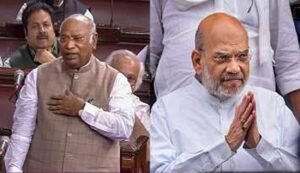
The debate quickly turned confrontational when the Home Minister referenced a query raised by a senior Congress leader in the Lok Sabha on Monday, who had questioned the necessity of discussing ‘Vande Mataram’ at this juncture. Shah followed this by alleging that the Congress party was responsible for fragmenting ‘Vande Mataram,’ which, according to him, eventually led to the partition of the country. This statement immediately provoked a strong reaction from Mallikarjun Kharge, the Leader of the Opposition and a Congress MP in the Rajya Sabha. Kharge strongly protested the Home Minister’s remarks. The Chairman of the Rajya Sabha, C.P. Radhakrishnan, intervened, assuring Kharge that he would be given an opportunity to speak, and requested him to take his seat.
Tumultuous Opposition and a Plea for Order
Despite the Chairman’s intervention, Kharge remained unyielding and continued his protest, leading to a loud uproar from the treasury benches. Amidst the chaos, Amit Shah remarked, “Kharge Sahab, your time will also come. You have been given plenty of time to speak.” The Chairman reiterated his plea, urging Kharge to be seated, which eventually brought a semblance of order to the floor. Continuing his address, Shah described the immortal composition as one that “awakens the feelings of dedication, devotion, and duty towards Mother India.” He stressed the enduring value of this patriotic hymn, transcending political divides.
Separating Patriotism from Electoral Politics
The Home Minister categorically stated that those who fail to grasp the importance of this discussion today need to undertake a thorough re-evaluation of their understanding. He addressed the speculation surrounding the timing of the debate, noting that some individuals were attempting to link the commemoration to the upcoming elections in West Bengal. Shah criticized these attempts, stating that connecting the glorification of the national song to the Bengal elections was an effort to diminish its national importance and significance. He warned against using such a deeply meaningful symbol as political fodder.
The Genesis of an Immortal Anthem
Shah reminded the house that a similar discussion took place in the Lok Sabha on Monday, where several opposition MPs, including those from the Congress, had questioned the need for a discussion on this issue at the present time. Shah acknowledged that the immortal work was composed by Bankim Chandra Chatterjee in Bengal. However, he emphasized that the composition rapidly spread not only across the entire nation but also among freedom fighters globally. He passionately spoke about the song’s legacy, noting that even today, when an individual makes the supreme sacrifice for the nation on the border, they chant this very slogan.
The Last Cry of the Valiant
Further illustrating the song’s deep integration into the national psyche, Shah highlighted its presence in moments of ultimate sacrifice. He shared that even today, when a police officer lays down their life in the line of duty, the last words on their lips are often ‘Vande Mataram.’ This spontaneous, heartfelt invocation demonstrates that ‘Vande Mataram’ is not merely a song but a fundamental element of the nation’s spirit and commitment. This enduring legacy has cemented its status as a core symbol of Indian patriotism and duty.
The Historical Context of Cultural Defence
Shah eloquently detailed how ‘Vande Mataram’ quickly evolved into a powerful symbol of patriotism, sacrifice, and national consciousness during the freedom movement. He drew attention to the socio-political backdrop against which “Bankim Babu” wrote the song: a time marked by attempts of Islamic invaders to erode Indian culture and the efforts of British rulers to impose a new system. The song, therefore, emerged as an anthem of cultural defence and national revival, making it an essential tool for mobilizing the masses toward freedom.
A Timeless Commitment to the Motherland
Concluding his address, the Home Minister delivered a powerful assertion about the timeless relevance of the national song. He argued that the need for dedication to ‘Vande Mataram’ was paramount when it was first composed, during the heat of the freedom movement, and remains equally vital today. Looking ahead, Shah firmly declared that this devotion will endure even in 2047, when the nation envisions the realization of a “Great India.” This sentiment cements ‘Vande Mataram’ as a permanent fixture in the nation’s journey and future aspirations.